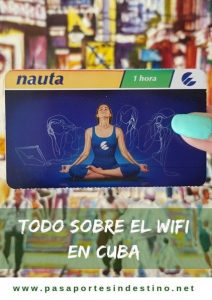
Unlike the majority of the countries, connecting to the WiFi in Cuba is not as simple as just connecting to an open network and entering a password. The first step is to buy a NAUTA scratch-off Internet card for having access to the WiFi network offered by ETECSA (the state-owned Telecommunications Company of Cuba S.A, responsible for providing communication throughout the country). The card, which is valid for 30 days, costs 1.00 CUC for one-hour of internet access in Cuba; 1-hour and 5-hour cards are the most offered ones. If you have not used your full one hour, then the credit will be available for you to use it again. Definitely, NAUTA cards would be your cheapest and most convenient option.
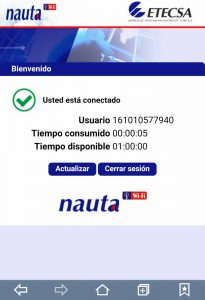
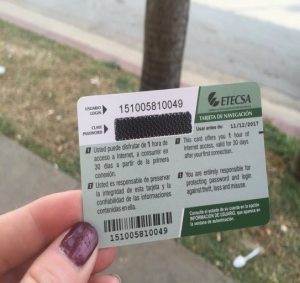
Once you find a WiFi spot, you ought to turn on the WiFi, select the “ETECSA” network, and a screen should pop up asking you to log in. Then, you should enter the username (usario) and password (contraseña) found on the back of the scratch-off Internet card. If your browser does not pop up with the log-in screen, you can open the browser and type: “1.1.1.1”. In order to log off, you should simply go back to the screen (type 1.1.1.1 if you do not have the Nauta screen up yet) and click the “Cerrar sesión” button to logout. Finally, a confirmation notice must appear.
Another choice to use the Internet on the island is to purchase a temporary Cuban SIM card with data, which is more expensive (the initial cost is 40 CUC). Keep in mind that you do not get back the remaining 30 CUC; consequently, 10 CUC of data is all you will have. Afterwards, you can top-up if more data is need.
Furthermore, Etecsa has already begun to market Cubacel Tur, a temporary telephone line, acquired through international distributors, aimed at tourists from different parts of the world who visit the Island. This SIM has a life cycle of 30 days from its activation, and includes a basic package and additional ones. The basic package has a cost of 25 dollars and includes 1 giga of data for internet connection, 20 minutes for calls, and 20 text messages. The additional packages consist of an additional 600 megabytes for $ 7; 1 additional giga for $ 10; 2.5 additional gigabytes for $ 20 and 4 additional gigabytes for $ 30. Bear in mind that additional packages specific to this type of product must be purchased through international distributors. Nor can it be recharged directly at a commercial office of ETECSA. Cubacel Tur cannot be recharged with money, so international recharge promotions do not apply. The client can pick up the Cubacel Tur directly at the José Martí Airport, Terminal 3 at the CubaTur counter.
Where can you buy Nauta Internet cards?
Nowadays, there are 1034 hotspots where you can access the WiFi in Cuba. A full list (in Spanish) of these zones can be found on the ETECSA site. Moreover, there are five places to buy NAUTA Internet cards:
- ETECSA office: This is the official place to buy Internet cards. You are required to show your passport and you are limited to buy only 3 NAUTA cards at a time. Most ETECSA offices are open from 8:30 am to 7:00 pm; however, they might run out of WiFi cards sooner. Be ready, you will probably need to wait in line.
- Hotels: NAUTA cards, which allow you to connect to any ETECSA public WiFi hotspot, are also sold at hotels and you do not necessarily have to be a guest to buy them. Besides, you do not have to show your passport here. This may look as the ideal option; nevertheless, you will be charged extra money and the WiFi won’t be much faster. In hotels, generally, cards cost 2 CUC per hour; but in the Old Havana, for example, since it is a main touristic neighborhood, a hotel may charge 8 or 12 CUC per hour.
- Parks, squares, or promenades: If you do not want to wait in line, hotels are not the only places to visit. It is often worthy just going to public parks, squares, or main promenades. Usually, there are locals walking around these places selling WiFi cards. They are re-selling them; therefore, they will charge you an extra from 50 cents to 2 CUC per card. These cards are totally safe, just check they haven’t been scratched off yet.
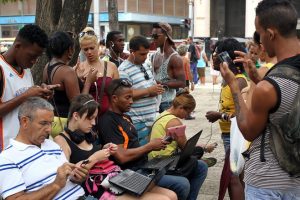
- Other resorts and casas particulares: Restaurants, cafes, and shops surrounding the WiFi hotspot may offer NAUTA cards as well. In addition, in 2019, WiFi extenders became legal with a license. As a result, there are currently several casas particulares where hosts sell them to their guests.

- Local Community: The most popular place where cards can be found is the local community. There is a considerable amount of locals selling cards from their houses. There will be always a sign out of their windows.
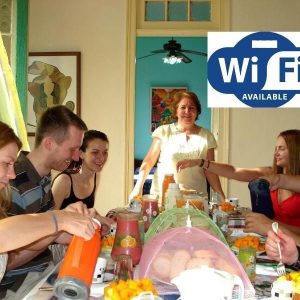
Internet in Cuba is going through dramatic changes. Bear in mind that 3G mobile Internet began in Cuba on December 6th, 2018. As time went by, new locations open up, Internet speed improves, and prices decrease. Nowadays, Cuban population enjoys 4G service, which has been a huge improvement regarding communication technology. Let’s hope that these technological advances in telecommunication continue in our country, to the point that it could become a digital destination in the future.
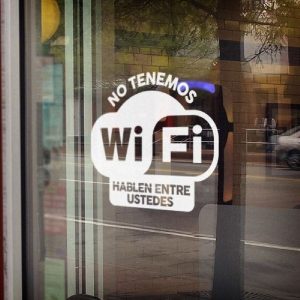
Despite all these achievements, there are still many efforts to undertake when it comes to improving the telecommunication industry in Cuba; there are numerous regions in the country where people have never got connected on the Internet, especially out of the capital city, in the countryside. “There is no WiFi, talk to each other” are humorous words that some facilities may show to their guests, making them laugh and foster an effective communication and relationship among them. This is also part of the sheer magic of Cuba!