

Waking up and smelling an aroma of coffee is one of the absolute delights of my life! Since my dad began to roast and grind the coffee himself some years ago, drinking coffee has become a well-established tradition at home. There is nothing better than taking a cup of the strong and sweet Cuban espresso in the mornings and after meals.

Coffee is a highly popular beverage around the world. In Cuba, the consumption of café cubano is a daily, cultural and social activity. Every Cuban is welcomed to a friend’s or relative’s house with a cup of coffee. Cubans are very serious about their coffee time while having a visit to gossip and catch up with neighbors, loved ones, and friends. It is a tradition very much still alive! In the present article, the Cuban family secrets of one of the most widely consumed drinks in our country will be unraveled.
Overview of the history of Cuban coffee
Coffee came to Cuba in the mid-1700s, and soon Cuba became a large coffee producer and exporter. By 1790, important amounts of Cuban coffee beans were being exported to Spain. Moreover, Cuba’s coffee bean industry expanded when French coffee farmers who fled the revolution began farming coffee in Cuba. From that moment on, in the 1820s, coffee bean sales exceeded Cuba’s sugar sales. By the early 1950s, Cuban coffee bean exports reached 20,000 metric tons. Afterwards, when the Cuban Revolution nationalized coffee farms, the decline of the Cuban coffee bean industry began. The coffee production continued to reduce during the 1960s and 1970s. However, it surged again in the late 1970s and into the 1980s, with the Soviet Union as the main benefactor and economic supplier of Cuba. Finally, with the fall of the Soviet Union in 1990, Cuba’s industry once again began to decline.

Coffee growing regions
Nowadays, Cuban coffee is grown essentially in three regions: the Sierra Maestra mountains in the east; Escambray in the central part of the island, and Guaniguanico, Pinar del Rio in the west. The majority of the coffee grown for export comes from Sierra Maestra and the coffee used for domestic consumption is mostly from the Escambray mountains. The favorable, warm Cuban climate and the fertile, reddish-brown soils, rich in humus allow the coffee cultivation without the need for chemical fertilizers, making the organic Cuban coffee one of the best in the world. In fact, coffee production has had such a great impact on the Cuban landscape that the first coffee plantations have a place on the UNESCO World Heritage list.
How to make the traditional café cubano?
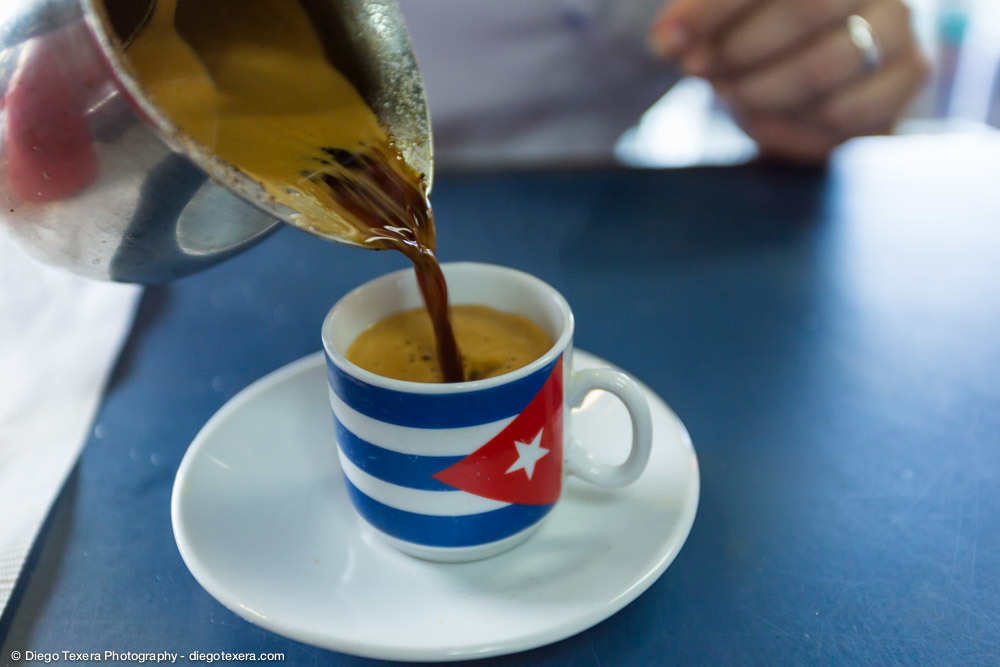
The making process of the Cuban traditional coffee is very simple and peculiar: once the finely ground dark coffee begins to brew, remove the coffee maker from heat and pour a little bit into a pot with the sugar. The sugar is beaten or whisked thoroughly until the bit of coffee melts down the sugar and you get it nice and foamy (a light brown paste). Then, the rest of the brewed coffee is added to the mixture. Finally, it is served espresso style in a small coffee cup, resulting in an “espumita” or light brown foamy layer sitting on top of the beverage. This is how you get the unique, special flavor of a Cuban coffee!

Other types of Cuban coffee
As illustrated before, the traditional and favorite type of Cuban coffee is brewed with ordinary coffee beans and sweetened with sugar. Nevertheless, there are other types of national coffee that taste as good as the desired espresso. Find out a type of coffee that will hold up to your preferences:
–Cortadito: It is a café cubano topped with several tablespoons of steamed milk.
–Colada: It is a larger cup of café cubano that comes with smaller Cuban coffee cups to serve your guests. Perfect for sharing with friends!
–Café con leche: It is a café cubano that comes with hot, steamed milk in a separate cup, and you simply pour the milk into the espresso.

Best brands of Cuban coffee
Cafe de Cuba, Serrano, Cubita, Regil, Turquino, El Arriero, La Indiana, Caracolillo Combo Pack are only some of the well-known Cuban coffee brands with very rich taste and exclusive aroma. They all have a distinctive flavor, which makes consumers yearn for a sip of coffee every once in a while during the day.

In Cuba, coffee is not only a drink, it symbolizes socialization and hospitality. Coffee represents a way to bring people together. It is a vehicle to share with guests and enjoy special moments with the people you love. It is pleasure, culture, and tradition. If you are a coffee lover, make sure to try Cuban coffee during your visit to our beautiful Island!